Thursday, January 31, 2019

The Gospel in the Greatest Showman: "This Is Me"

“I am not a stranger to the dark. Hide away, they say, we don’t want your broken parts. I’ve learned to be ashamed of all my scars. Run away, they say, no one will love you as you are.”

I know you are seeing the bearded lady right now. But I want you to imagine another woman for a minute. She lives in a hot climate with no access to running water, so she and all the other women she knows walk to fill up their jars with water and carry them home. Here, like in other places where the sun beats relentlessly in the middle of the day, most people plan their hardest work in the early morning or late evening. This woman can choose to avoid the scorching heat or choose to avoid the scoffing crowds. She chooses to avoid the crowds. She has acquired a bit of a reputation as she has moved from man to man. In her culture once a woman has been with a man, she either stays with him or is considered a second-class citizen. Maybe even an untouchable. So here she is at noon, in the heat of the day but with no crowds in sight, walking the several miles to the water well with her jars. A man walks over to her and wants her to give him a drink of water. She’s stunned. Why is he talking with her? On top of the fact that she’s disreputable, he’s from the south. His people look down their noses at her people. Isn’t he afraid of someone seeing him talk with her?

The story goes on. While the man may have been thirsty, it turns out he was making an elaborate point about water. The water he gives is living water; it never dries up. It flows up to eternal life. The man is Jesus. And the woman didn’t offend him. It’s not that he was naive. In fact, he told her everything she’s ever done. He saw her broken parts. He saw her scars, visible and invisible. And he didn’t condemn her. But he did change her. Instead of remaining in hiding, only going out when the crowds were at their thinnest, she went to the biggest crowd she could find and told people about Jesus. “Come! See a man who told me everything I’ve ever done. Could this be the Messiah of God?” Jesus told her he was this Messiah, this promised deliverer.

“This is Me” is a top hit because everyone is looking for an answer for shame. Sometimes we feel shame in our own lives and long to see it covered. Or we rejoice when we see other people come out of hiding because they finally feel they don’t need to be ashamed of who they are. Whether it’s our own shame or someone else’s, we are burdened when we feel it and rejoice when it’s gone.

Jesus has an answer for shame. In Isaiah chapter 54, the prophet says that when God restores His people they will not be ashamed or disgraced. They will even forget the shame they have been living in. They will forget this shame because God, who made them and knows everything about them, will set them free and make them his own people again.

The thing about shame is that we have to be fully seen in order for shame to be fully gone. Otherwise the lingering doubt remains.. “But if they knew about this issue or that habit, they wouldn’t love me.” No one would be crying happy tears for the bearded lady if she sang behind a curtain the whole show. It’s because we see her in the spotlight - in all her bizarre freakiness -  that we love her for her braveness, for her voice, and for refusing to stay hidden.

Who can more fully see everything shameful about us than our Maker? We can show our best face to the world, but our God cannot be fooled. He sees anything that’s ugly in our hearts or in our minds. He sees anything - and everything.

But amazing grace is this: He sees it all, and he took it all. Took it all to the cross for us. Paul writes in a letter to the Colossians that Jesus cancelled the debt we owed, nailing it to the cross.  He died a criminal’s death for the public to see and mock. He died this death, so that when God looks at us, instead of shaming us for our weaknesses and ugliness, He can instead see the perfection of His son, Jesus.

We don’t need to be ashamed of who we are. But Jesus won’t leave us as we are. He makes us glorious. Not because he sees the ugliness and calls it beauty. But because He sees the ugliness, took the ugliness, and gives us beauty. He gives us a new heart and a new spirit. A new freedom to be who God, our Maker, created us to be. I am not who I was. God has given me a new heart with freedom to walk according to His perfect design. Please understand, I am also not who I will be. But the things in me that are ugly have been forgiven and are being changed. And the things that are beautiful are because of His Spirit living inside me.

What amazes us about the story of the Samaritan woman is not that Jesus was kind to a perfect stranger. It’s that He welcomed a perfect sinner. He knew everything she had ever done, welcomed her near, and offered her life that was worth living.

New heart, new spirit, new hope, new joy, new life. This is Me.

Sunday, January 13, 2019

What The Greatest Showman shows us about ourselves... and our intelligent designer

In the song "Come Alive," PJ Barnum is talking to his motley crew of “unique persons and curiosities."

“You stumble through your days, got your head hung low, your skies a shade of grays. Like a zombie in a maze, who is asleep inside, but you can shake awake. ‘Cuz your just a dead man walking, thinking that’s your only option.”

In The Greatest Showman, Barnum beckons his crew to “come alive, go and light your light, let it burn so bright.” This song marks a turning point in the movie and begins to capture the audience. Why? We see people coming out of hiding. People like General Tom Thumb. The bearded lady. When you see them appear in the movie, I bet most of you don't feel they belong behind closed doors. PJ Barnum pulls them out of the shadows and shows them, and the world, that they belong on a stage. We see them coming to life, and this new life springing forth makes our hearts sing. I think this song makes our heart sing because it stirs the deep longing in our souls to have life that is truly LIFE. God, the great designer, wired our hearts this way - to celebrate others coming alive and to desire full life for ourselves.

PJ Barnum has inspired America to find the stage-worthy in everyone and to celebrate what makes us unique. We are captivated with the life he brings out in his circus crew, and we long to see ourselves and those around us truly come alive in the same way. We find PJ Barnum captivating because we see in him a shadow of someone even greater than himself. I know someone who truly offers new life. This someone spoke and made something out of nothing. He breathed life into flesh and bones to make a living, moving being. He walked on the earth Himself. This someone is Jesus. And Jesus said He came that we may have life, and have life ABUNDANTLY.

Paul wrote many letters to newly formed churches that are part of the Bible we have today. He could have sung "Come Alive" to the Ephesians. In his letter named after them, he reminds them who they were and who they are now. “You were dead,” he says, “living in your sin and lawlessness, walking in the way of the world, just as we all were when we were controlled by the desires of our body and mind. But God gave us so much we didn’t deserve. He loved us with an incredible love we didn’t deserve. Even when we were dead, unable to make ourselves alive, God made us ALIVE together with his Son, Jesus. Jesus was dead - really and truly dead - when God made Him alive. And in the same way He made us alive, giving us life that is truly life.”*

This life that Paul talks about is the kingdom of God, the kingdom of heaven. This life is eternal life. It comes through Jesus and is available to us, in part, on earth. This eternal life will come in full when Jesus returns. And He will return. The book of Hebrews in the Bible tell us that Jesus came once to take on the sins of the world. And that He will come again to save those who are eagerly waiting for him. This second coming is something we can only begin to imagine. No tears, no pain, no sickness, no death. 100% freedom to be in the presence of God: happy, whole, without guilt or shame. If The Greatest Showman makes your heart sing like it does mine, it does so because it is whetting your appetite for the abundant life that Jesus has brought in part and will bring in full. As CS Lewis said, “If you find yourself with a desire that nothing in this world can satisfy, the most probable explanation is that you were made for another world.”

Do you listen to this song and feel hope budding in your heart? Do you see the General and the bearded lady come alive and crave that same freedom for yourself? This craving is God stirring in you a desire for abundant life. He created you to have the desire, and He made a way to satisfy it. If you hear this song and your soul wonders “does God really want this kind of free, abundant life for me on earth?”... the answer is “Yes! God wants it for you and for me. For anyone who will come to Him believing He is the designer of life and the answer for everything our souls crave.” And, as PJ Barnum says, “once you see it, oh, you’ll never, ever be the same.”


*I'm paraphrasing Ephesians chapter 2, verses 1-6

Tuesday, February 24, 2015

Nick's new job

Although we are back from Africa, Nick is still part of his international fellowship. He is rotating in areas that will continue to give him skills useful overseas: dentistry, ultrasound, trauma, and burn care. He is working approximately normal hours every week (woohoo!!!!!) and doesn't have call very often, so he has taken to... being lazy (just kidding!) ... redoing the house we will be moving into. His project last weekend was to put on new doors. Let me give you a little visual for what I mean by "redo."


He's in what will be the laundry room and storage closet. To the left is a closet frame he and a very gracious friend worked on before we left for West Virginia and Africa this summer. The house was actually built as a duplex, but has since been changed into a single-family dwelling. So this room originated as a kitchen. It was about 20 degrees and snowing while he was working, so Nick used some kind of turbo space heater to keep from freezing.


This was an old living room. It had an interesting glass window which looked into, we assume, a daycare play area. Like the art work? We will paint over it :) The old play room will be Moriah and Charlie's room. They love sharing a room and will probably do so for as long as is socially acceptable. The old living room will be a nice guest room with its own entrance. "It's own entrance" sounds kind of fancy. Don't be fooled. Fancy is not exactly what we're going for. Definitely livable, hopefully enjoyable, but not fancy. Investment property? Um, sure. Depends on what kind of investment you're talking about... 

Here is the fanciest part of our house though- the new front door and the fireplace. The fireplace was also helpful for keeping Nick manageably warm.


You can see we have some work cut out for us... cheesy pun intended. We plan to move in towards the end of June, when Nick is finished with the international fellowship and before he starts at a non-profit clinic in Wichita. So we have quite the work ahead, but we're excited. Several other residency friends, many of whom will be working at the same clinic, have already moved into the neighborhood. Our friends, Drew and Lindsay, bought the green gem of a house next store. Others are literally a zip-line-ride-across-a-creek close.

Our move is part of a cool journey, one that started shortly after we were married. Nick and I talked often about the "Love your neighbor as yourself" statement of Jesus' that is plagiarized as the Golden Rule ;) As we talked about how to be doers of that command, we felt God challenge us to choose our neighbors carefully. So we have been on a journey of trying to live in places not because of what we can afford, or because of how much space we want, but in places where we think God wants us to be neighbors.

And so begins the blog-umentary of our reno process and move. Someone is tired just thinking of it :)


Friday, January 23, 2015

The Second Most Important Oven in Niger

I asked Anna* if she wanted an oven. She replied with a "Yeah, but they didn't give us much notice for the sale, and I haven't had time to save money." I told her if she had an oven she could make her delicious homemade bread for other short-term workers at the hospital. She made us amazing homemade rolls and bread in our home each week. We usually gave away about half to the compound bachelors or other short-term missionaries who didn't have someone baking bread for them. The compound housing committee was offering old appliances to workers for a good price the coming weekend. As we continued to talk, she asked to borrow money from us and have it taken out of her salary each week. We talked about it, prayed about it, and decided we were excited to help her.

With an oven, she was well on her way to having a home business. She still needed several other important things: a gas tank, pans, measuring spoons, a roller, etc. These things may seem insignificant but none of them could be bought locally or at an affordable price for her. We only had about 4 weeks before we left. We wanted to help her make this happen, but wanted to be really careful not to throw all these things at her carelessly.

You probably think we wanted to avoid being taken advantage of. When people receive handouts upon handouts, they often develop an attitude of entitlement: they feel they deserve what they are given, or feel what they are given is not good enough. I want to offer my theory on entitlement. It has developed over time... from a year in a poor village in Thailand and several years getting to know inner-city Wichita.

When God created man, he created man and woman to work. To take a fruitful garden, rule over it, and subdue it. To take resources He gave them through the earth and provide food for themselves and their offspring. Work is good. I believe God created work, in part, to be dignifying: it just feels good to be able to take care of myself and the family God has given me. And it's enjoyable to be creative - taking something that seems ordinary and making it special. God gives us natural resources and the mental and physical capacity to maximize those resources so they produce something that works for us.

For example, my husband earns money for food, and I take the food and make it into regular, nutritious meals for my family. I can do this, and I usually do. Let's say our situation changes, and I, in fact, am not able to provide for my family. Lack of money, lack of physical capacity, lack of mental capacity, whatever. Legitimately, I have had times where I was mentally incapable of wrapping my brain around putting food on the table for my family. Thankfully, we have been in a position during those times where Nick could either grab take out or get cereal for himself and the kids while I took a time out.

I usually feel some guilt and shame when this happens: "What is wrong with me? Why can't I handle my life right now - it's not that complicated?" But Nick has always been very reassuring and gracious, and the Lord has always restored my sanity in a short time. But if I had continued to live there - unable to get my family regular, nutritious meals - I would have started to feel increasing guilt and shame. Dealing with guilt and shame is not easy. We do a lot of things to cover these emotions up or brush them off - get defensive, blame someone else, make excuses. This is where I think entitlement comes in. I think people start to feel and act entitled because it is easier to handle than guilt and shame. If I am ashamed I can't mentally handle feeding my family, I may start to act like I deserve for Nick to order us take out every night so that I don't have to cook. It's easier to handle my resentment towards Nick than my shame of my mental incapacity.

When we continue to take care of people's needs for them, I believe they tend to develop guilt and shame. When people legitimately cannot take care of their needs, they do not need to feel guilt and shame. If we come alongside them in a helpful, careful way, we can meet their needs or assist them in meeting their own needs in a way that appreciates God's design for work. We can encourage them to deal with any guilt and shame by looking to their God and Savior, not to the world, to see what He thinks about their lives and purpose. But when people can legitimately meet their own needs, or when we are not careful in coming alongside them in a way that appreciates God's design for work, I believe the guilt and shame increase and often lead to entitlement.

With Anna, we were more concerned about not inadvertantly shaming her than about her taking advantage of our help. She is fully capable of providing for herself and her family. Truthfully, she is a much harder worker than I am. (Try doing all your family's laundry by hand - in the 100+ degree sun and with chronic anemia - and then pounding your grain by hand, feeding your goats, carrying water for your family, and then doing all this for someone else's family. Then let me know when you need a break!) I also know that Anna, because of where she lives, has so fewer resources than I do. Food doesn't grow well, produce is scarce and expensive, and no one has found valuable minerals in Galmi to mine. So I want to help her better provide for her family. But in a way that honors her ability to work hard and conserves the joy it gives her, not in a way that dismisses these things. Also, I want to be really careful, for her sake and mine, that I don't have a savior mentality**... If only I gave Anna what I had, she would be okay. If only I helped her, her life would be better. God provides for my needs, and I need to remember that He is the one providing for hers. He may very well ask me to share the plenty I have with her, but I am certainly not her savior. The plenty I have is from Him anyways.

So, yes, we could have easily thrown out $200 to get her bread business up and going. And doing so, truthfully, would have been quite easy. But, no, I did not want her to feel like she had a new business because someone gave it to her. So, before she had her own supplies, she came over to make bread and tortillas with our oven. We sat down together pricing out all the ingredients and how much a batch would cost to make. We measured bags of flour so she would know how many bags she would need to buy each week. We walked around the compound taking bread orders together to boost her confidence in doing it by herself. And we prayed for God to help us find a way to get gas, a rolling pin, pans, an oven thermometer. In exchange for our gas and ingredients, she left some bread with us and sold the rest. The look on Anna's face as she delivered her delicious bread to people was priceless.

Who could resist delicious rolls from this gorgeous smile?!?


She saved money to buy her own ingredients and some supplies we could find locally and inexpensively. God answered our prayers for hard-to-buy things in creative ways, which was fun to watch! She was grateful for our help, sure, but I really think she saw God, not us, as the providers. She repaid and worked off her loan for the oven, and started brainstorming ideas about how to save money for the gas after we left. Our surprise to her the day before leaving was a gas tank. We checked around with missionaries who had been there much longer than we had, and the gas tank gift was reasonably similar to a cash gifts families usually give their workers around the holidays. What a perfect way to thank the precious woman and dear friend who spent so much time caring for our family.

We hear from our friends that she continues her weekly orders and delivery. So if you are ever passing through Niger and want homemade rolls that may be getter than your grandma's, make sure to be around on Monday evening when she takes orders :)


*Due to recent events in Niger (you can google it) and because families we know are being affected, I am working on changing names in my blog.

**This idea comes from When Helping Hurts: How to Alleviate Poverty without Hurting the Poor and Yourself. It's also a great read for learning how to love poor people well.


Friday, January 9, 2015

Niger: Pizza ovens and People's lives

We decided on a "stay-cation." Nick and Parker had been working for about 3 months without any time off. They asked for a four-day weekend, so we were deciding what to do. In case you couldn't tell from pictures, Niger doesn't offer much in the recreation department. We could have chosen to spend the weekend in another rural town in Niger, but packing up two kids and food just to have different red soil and African thorn trees to see didn't seem too appealing to me. So we chose to stay put and do some things we had wanted to do for awhile, but hadn't had the time. Like go for a long walk through the fields. Like fly our kite with Anna's son, DJ. Like sleep in. And for Nick... build a pizza oven. Hundreds of hours watching YouTube videos and reading articles were finally culminating in an actual pizza oven. The process was intense.


A hospital translator connected Nick with a brickmaker so he could learn about mixing clay soil and where to find it. A guy from the compound shop helped him find a pile of rocks he could transport to build the base.


Another guy knew another guy who would sell Nick some straw and millet chaff so some of the clay would have more structural integrity.

Hausa people are big on greetings. There are 3-4 standard questions you almost always ask when you meet someone on the road. "How's your morning? How's your work? How's your tiredness? How's your family?" During this oven-making process, the greeting Nick and I often received was "How's your oven?"

The hospital and missionary housing compound had 3-4 guards working most of the time. ("Guards" is a bit of an exaggeration, they were mainly there to keep away door-to-door trinket sellers and to kill snakes. Both of which they did well!) All the guards stopped by at least once on their rounds to check out the oven and compliment Nick's work. One of our favorites even helped Nick for a few minutes. The shop guys started coming by as well.


The local people are very grateful for missionary doctors coming to offer health care for people who need it so badly. And they have high admiration for health care workers since most local people have not finished high school, let alone post-graduate school. But when they saw Nick could work with his hands and make something from the ground, they had a respect for him that no degree could bestow. I'm going to differentiate between admire and respect. I don't know what Webster's has to say about it... but when I admire someone, I think what they are doing is impressive.  However, when I respect them, really respect them, I think what they are doing is legit. Hopefully you catch my drift?

The 4-day weekend was close to the end of our time in Niger, but it was a clear turning point for our relationships with local people. Our language had really taken off, and Nick was doing work the Hausa people could finally relate to. Don't get me wrong, the medical work was amazing. Nick saved countless lives with his training and some basic medicine. And that's important. Jesus healed people, and He has given Nick training that allows him to do the same. And while we want Nick to use his training to benefit people's lives, we didn't go to Niger just to buy some people extra time on earth. We went because Jesus has changed our lives. He has given us peace with our Heavenly Father and a joy beyond anything this earth can give. He has given our lives purpose by calling us to build His house, His "kingdom" that will last forever. And we want to see Jesus change Hausa lives, too. We want to see Jesus change American lives for that matter: the lives of our kids and parents and siblings and neighbors. But Nick has a profession that is needed in countries across the world - countries where there aren't very many people who want to see Jesus change lives. Countries where most people have no idea that Jesus does change lives, or that God even cares about them enough to want good for them.

We weren't in Niger nearly long enough to see lives really changed for good by the gospel. But we went for training so that someday we are better equipped to go to a place and see that very thing happen. Lives may be impacted by doing medical work in Jesus' name, but lives won't be changed unless we really enter the world people are living in and live it with them. While medical work may get us to a place, building a pizza oven seems more likely to get us into people's hearts and lives, the places where respect is earned and where the life-giving life of Jesus can take root and change a person.

Tuesday, January 6, 2015

When People Become Precious (written Nov 30, 2014)

I remember writing a blog post with this exact sentiment when I left Thailand after a year to come home and get married. I may have even titled it the same. Today was one of those days. One of those days when being here, away from family and close friends, away from our favorite foods and yummy coffee drinks, one of those days when being here was easy. 

DJ
A gracious friend checked out a mission car in order to drive our family to the hometown of Anna, our house help. She was leaving for the weekend to go to the wedding of an extended family member. I asked her if I could come along. She was really surprised I was interested, but very excited. Her hometown is in the “bush,” which is the African way of saying the “boonies,” so it took a bit of planning to make it work. Anna went early and stayed late to help with preparations, so we drove her husband and "adopted"* son, DJ, with us. The groom was DJ's older brother.
Waiting for the wedding

We didn’t see much of the wedding, just the women dressed up in their best and some of the men drumming and dancing. But we saw probably every member of Anna’s extended family within a mile radius (a long distance when walking on sandy roads with flip flops!). And it was worth every step. Anna has become so dear to us. She feels like my Hausa Prang, for those of you who know of my dearest friend and sister in Thailand who was in our wedding. It was so special to be able to meet Anna's dad and sister and grandma and cousin… and cousin and cousin. It was so special to show her that the people who are important to her are important to us. And to have another shared experience that gives us even more of a connection.


We had to leave early so our friend, Deb, could drive us home before dark. Before we got in the car, Anna gave me a big hug. Not just an awkward “I-know-you-Americans-do-this” hug, but a strong one. In the car, Moriah can’t see Anna through all the people crowded around the vehicle so she hollers out “Where’s Anna? Where’s Anna?” Anna can see Moriah craning her neck and waving eagerly. As we pull away, Anna is visibly choked up. Hausa people do not choke up often. They say “You can cry in your heart, but not in your eyes.” Kids are chasing our car, and Anna keeps walking with them. Now her face has broken out into a huge smile with her teeth shining bright against her dark face. She is waving happily.

My heart is overwhelmed with all kinds of feelings - joy, sadness, privilege. Joy for being able to catch a glipmse of Anna’s childhood and see her family. Sadness for the impending goodbye that is coming in under two weeks. Privilege at being able to know such a special women and being able to call her our friend and sister.


I was describing our day to a fellow missionary and said, “These are the moments when you say ‘This is why we’re here.’” Then I said, “Actually a better way to describe our day is that these are the moments when being here is easy.” 

Leaving Starbucks and fast food and jeans and putting on head coverings and scarves and long skirts... we need to do these things if we want to have meaningful relationships with people here. And all these things are hard. When the people here become precious to us, however, that changes everything. All these things become easy when people become precious.

I thought about being in heaven one day, standing with Prang and Anna both. How did I get to be so fortunate that God would allow me to know such precious people? I’m sad that our lives are intersecting only for a season, but grateful that because of Jesus, our relationships can have significance for eternity. Relationships. They are the only investments that offer dividends when we leave this world**. Our relationship with God, and our relationships with the people He has given us to love.  If we invest wisely, and by the grace God gives us through His Spirit living in us, our dividends will be fellow worshippers with us in heaven, and more friends to walk with on that glorious day when God makes all things new. All things new. Jesus told us not to store up treasures on earth, where moth and rust destroy and where thieves break in and steal, but to store up for ourselves treasure in heaven, where moth and rust cannot destroy and where thieves cannot break in and steal. My Starbucks gets cold and my Brahm’s shake gets warm, and our mutual funds can be wiped out in an instant. But my Anna? She will be singing and dancing forever at the feet of Jesus. And I will get to be there with her. Even if she has better rhythm than I do. 


*I use adopted in quotations because adoption within Hausa culture resembles our understanding of the concept, but also has differences. Hausa adoption usually seems to happen within an extended family. Also, the adopted child seems to maintain the biological identity. For example, DJ’s biological parents were introduced to us as his parents, and his biological brothers were introduced to us as his brothers.

**I fondly credit my dear friend and mentor from my time in Thailand, Jim Larson, for this line of thinking from Matthew 6:19-21.


All photography credit goes to Deb Berruti


Sunday, October 19, 2014

An update from Nick

Considering that we are half way through our time here in Galmi, I (Nick) wanted to give a quick update from my perspective as Michaela has been doing much of the writing for our blog. I wanted to share a story and give a synopsis of my usual days. We have been really challenged as a family and I have been challenged personally as a husband, father, and physician here. Everything is different. Raising children and connecting with Michaela have had to take on a completely new appearance. I had never seen a case of malaria, typhoid, or severe “kwashiorkor” malnutrition before coming here and these are the “bread and butter” diseases here. I can think of one or two children that died on our pediatrics service in Wichita with our most intensive care. Here with the medicine that we are able to provide, children come in gasping for what seems to be their last breath and miraculously most of them get better. Death is a very harsh reality here that I have not seen the likes of before – nearly every day there is at least one of the patients that I had some role in their care that dies.

One of the things that we are learning that bridges the gap for us and we have had to rely on heavily is listening to the Spirit. Our sense of this need has been heightened with everything that has been new, different, and difficult. Though, truly living in the Spirit is and was a huge need we had even before we came to a new land. We actually had a chance to share some of our thoughts at last week’s church service here on the compound. The missionaries take turns leading the service each week, including the short termers. It was a great chance to think back and reflect on the time we have spent here as well as what comes next for us here as well as in our future. Below I mention one of the stories that I thought a lot about while preparing what we shared.

My usual day starts at about 8 am, rounding on the admitted patients in the hospital. There are 5 wards that are divided up between the children, men, women, isolation, and “intensive care” units. I have been rounding on about 20-25 patients a day and here this takes only about 2 hours! I then get a morning break from 10-10:30 and then have clinic for either adults or children. The clinics are always overflowing with people who come from hours away to get care. When I ask people why they come, they say it is the best care in the region and they trust the care and medicines that they get here. I generally get a lunch break from 1-3 pm and finish clinic at about 6:30 pm. I am on call about every 3rd or 4th day and in the evenings of my call I also usually take any of the C-sections that come in.
The compound we live on is directly connected to the hospital and the main road runs straight to our house. One of my favorite parts of the day is finishing exhausted from a full day at the hospital and beginning to walk down the road to find Charlie tootling towards me as fast as he can or Moriah running and yelling “daddy, daddy!” as they see me on my way.

I often have patients that I admit at the end of the day that I have to wonder if they will be alive in the morning. One of those patients was a little 3 year old girl (same age as Moriah) named Aliyah. She came to the clinic and had malaria with a superimposed pneumonia. She had a hematocrit (blood level) of 8 when normal is in the mid 30s from the breakdown of her blood cells by her malaria infection. I was unable to awaken her and she was limp with her eyes rolled back in her head. Her oxygen saturation which should be more than 90% was in the 60s and 70s. We do not have ventilators here but in the intensive care unit called the “uche” here we do have oxygen concentrators that can deliver up to 6 Liters of oxygen by a nasal cannula.

I ran her up to the uche and got oxygen on her, started her on antibiotics and antimalarials, and got her mother to get a family member to donate blood for her – the lab here has a blood bank that is a huge benefit to treatment but in order to get blood you have to have someone give a unit first. In the US she would be on a ventilator, seeing every intensivist in the hospital, getting 30 lab tests a day, and vital signs every 10 minutes. She would have tubes sticking out of every opening measuring everything that is measurable. Here she got transfused blood, 3 lab tests, antibiotics, and a little bit of oxygen. She laid on a bed with 2 other babies also needing oxygen – no such thing as single rooms, or often single beds for that matter!

This is the reality of most of my days, and many of my patients… And remember this is what the people here know to be the best care available, and truthfully I take pride in the care that we are able to give even with little resources!

Not being able to be a micromanager of care, monitor levels hourly, and give advanced treatment can be a really frustrating thing to a physician who knows what is available in other places. But it leaves much more recognition for me to be aware of the need for the Lord through his Spirit to intervene in and through us. When I would usually ask for more tests or a consult, I am left with prayer and asking the Spirit “what does this patient need that You can show me or You can do?” I am also reminded that it should not be my last resort, but rather my first.

Being left with nothing else to rely on except the Spirit that lives in us is actually a wonderful place to be. In John 7:37b-39 Jesus said: “If anyone thirsts, let him come to me and drink. Whoever believes in me, as the Scripture has said, ‘Out of his heart will flow rivers of living water.’” Through belief in Jesus we are filled ourselves with living water (the Spirit) and have the ability to spill over onto others.

So I came back the next morning and was with one of the translators. We came to the uche and I saw Aliyah. I was surprised she was alive, but she did not look good and was still limp and not responding. I watched for 3-4 minutes for any evidence of breathing and there was none. I pulled out my stethoscope and put it on her chest. Her heart was beating about 70 times per minute which is too slow for a 3 year old. I looked at the translator and said I think she is going to die. He agreed.

Usually there is little benefit to “bagging” a patient here with a mask as we are unable to ventilate them for long periods of time, but I thought we might as well try. I bagged her giving supplemental breaths for 5-6 minutes and then watched again for what seemed like an eternity for signs of breathing. The mother (who likely can’t read or tell time and has no idea how old she is or when her children’s birth dates are) was looking at me bewildered but there was a sense that she knew that it was not going to end well. I told the translator that there were no more medical treatments that we could do for the patient and that she was going to die. People experience so much pain and difficulty here that they don’t cry and generally don’t mourn outwardly. The mother had some tears in her eyes and was clearly preparing herself for the worst.

The mothers here all carry their babies on their backs as Michaela has talked about and shown pictures of in the previous blogs. All babies get carried out of the hospital on their mother’s back, regardless of whether they are alive or dead. This has been one of the most emotionally difficult things for me to watch in the hospital – a mother pick up her limp, deceased child and place him or her on her back, tie them on with a piece of cloth and leave the hospital to return to their village with a dead child. Only then to be greeted by a life of other sick and malnourished children, back breaking work, and no hope that comes from the creator and sustainer of life.

The translator, who doesn’t know the Lord personally yet, said why don’t you pray. Of course! It's sad that I have to be reminded again of the living water in me that my translator had seen at work and knew had power. I prayed for her to be healed and if she was not, that her mother would be comforted and through this time their family would come to know the Lord. And I left her there, not breathing at all.

The Lord does some pretty awesome things here, but this was the most awesome I have seen. I came back the next morning and she was awake, sitting in bed breathing on her own. The mother was ecstatic showing me how she was alive and breathing. I asked her through my translator if she remembered what happened and she retold the story. I told her I was thankful to God, that my medicines were not the thing that healed her and that the God who heals wanted her daughter to live and be healed physically, but more importantly to give them a new heart and a new Spirit. She listened eagerly with a smile from ear to ear. Every time I came back into the ward she greeted me with a raised fist above her head (reserved for those who hold authority) and a smile.

Here is a picture of Aliyah and her mother.  

One of the wives of the surgeons here who Michaela has written about before went up to see them in the hospital and took a picture book to explain the gospel to them in Hausa because she could not read. I discharged the little girl alive and much improved soon thereafter.

In Ezekiel 36 God says that the “nations will know that I am the Lord” and the means for accomplishing this is that he gives those who follow him heart transplants, replacing our heart of stone with a heart of flesh, and also giving us His Spirit inside us to be life to us. Seeing the nations come to know God is why we are here doing this fellowship and training for the future. It is so wonderful to be filled with His Spirit! Oh, that we would abide in him more fully and have a more complete union with him. He does awesome things and is at work in us.

Wednesday, October 8, 2014

Holiday Celebrations

*This post is a couple days late because of slow internet...*

Today is a holiday in Niger, actually in all this religious culture. Our beloved story of Abraham and his son on Mount Moriah is not simply a random one in a string of stories in the Old Testament of the Bible. While the story has special significance for us because of Moriah’s pregnancy story (written here), it is actually a pinnacle story for understanding God’s plan for bringing us back to Himself. The people here remember the story this weekend during Eid al-Adha, “Feast of the Sacrifice.” They literally slaughter a lamb to celebrate Abraham’s willingness to listen and obey God. Since they are celebrating this holiday right now, I wanted to write a little more about the significance of Abraham on Mount Moriah. Since this holiday is as big a deal as Christmas is to us, the story must hold some significance, right?

Remember that Mount Moriah is a descriptive story, it describes. It is not a prescriptive story, it doesn’t tell us what to do. This idea helps me to address my own question of “How is it okay for God to ask Abraham to put his son to death as an offering to him?” In other areas of the Old Testament, God clearly articulates His hatred for the fact that some people, in their total wickedness, offered their children as sacrifices. So, by including Abraham’s story in the Bible, God is in no way implying we should follow suit by sacrificing our kids. He wants us to know that He asked Abraham to do something very significant, and that Abraham obeyed.

So… God says to Abraham, “take your son… your only son, whom you love, and go to the land of Moriah, and offer him there as a burnt offering” (Genesis 22:2). God says He knows Abraham loves his son. God also points out Isaac is his only son. Abraham and his wife, Sarah, were childless into their late, late years. To prove to them that He could make something out of nothing, God tells Abraham he will have a huge number of descendants. God will uniquely bless these descendants, and God will use these descendants as a tool to bless the whole world. God tells Abraham that through Sarah, his barren wife, he will become a father of many.  You know the song? Father Abraham, had many sons, and many sons had Father Abraham. God promises Sarah will have a son named Isaac. And God says Isaac will inherit the promised blessing as well as the responsibility of being a blessing.

Abraham may have had some deliberations about God’s astounding request, but all we know is that “Abraham rose early in the morning… and went to the place of which God had told him” (verse 3). He lays the firewood on Isaac to carry, and Abraham carries the knife and the tools for the fire. Isaac asks Abraham where the lamb is for the sacrifice… “God will provide for himself the lamb,” Abraham answers. So up the mountain walks Abraham and his son, his only son, whom he loves, carrying wood on his back. Sound familiar?

At the top of the mountain, Abraham lays down the wood, puts Isaac on top of it and takes the knife in his hand to kill his son. “Abraham! Abraham!” says an angel of the Lord. “Stop! I know you trust and revere God because you even gave him your only son” (a paraphrase of verse 12). Abraham looks up. What does he see? A male lamb is caught in a bush. So Abraham offers the lamb instead. In the post about Moriah’s birthday, I summarized our commentary of this story as “God will provide for us what He is asking from us.” What He asks from us is so much greater than energy and strength and patience and love to care for a special needs child we thought we were having. He asks from us total obedience, for us to always do what He says is good and to avoid what He says is bad. He is our Father, so He knows what is best for us. He knows we don’t always understand why it’s best. Still, He asks us to listen to Him on the premise that He is God and we are not. Sadly, we often don’t listen. We don’t believe that He is God and He knows best. This failure to listen, failure to trust? That’s our sin. It’s a problem. It separates us from God. When we are eternally separated from God? That’s hell. A scary place to be sure.

Some people might not see it as a problem. “Sin and hell are what religious people use to scare people into coming to church or doing ‘good things,’” some  say. If you are one of those people, that excuse may work for awhile.  But I’m going to venture... that someday you will be nagged with the sneaking, but unshakable, suspicion that you are, in fact, estranged from the God who formed the universe, the God knows everything about you.

Okay, it’s a problem. This sin. This not listening. What can I do about it? Go to church more? Do more good things? That’s what many people here are doing. They learn that praying, that following standards of not eating pork, that sharing with the poor, that all these duties will take care of their sin problem and restore their relationship to the God who made them. In fact, they are so convinced they have a problem that separates them from God they spend a weekend physically killing a lamb and eating it together in order to make themselves right with God.

We’ve read that before the sacrifice someone writes a list of people’s names on a piece of paper. They slaughter the lamb in order to wipe away the sins of the people on that paper. Are they confident the blood of a simple bleating lamb actually takes care of this huge problem? I don’t think so. I think that’s why dozens of people here are hungry for words of truth about how to mend our relationship with God. Just this last weekend, a local religious leader invited a Nigerien hospital worker and his wife to a large mosque in the region to teach children about the way to God. Why would they ask a Christian to teach in a place where they learn about their own religion? I think they ask because they are keenly aware of their estrangement from God and are hungry to have this problem fixed.

So again, what can we do about our sin problem? God will provide for us what He is asking from us! Did you catch what God was giving a “sneak preview” of with Abraham and Isaac? The son, the only son, the beloved son, carrying the wood on his back, up the mountain, as a sacrifice. It’s Jesus. The sacrifice of Isaac was a preview for Jesus! The Father, who gives up His son? Who would dare ask a Father to give up a Son? God gave up His Son, voluntarily. Jesus carried His cross up that hill, voluntarily. He went through with it. There was no lamb that day. Jesus was the lamb. The Lamb of God. When Isaac asked about the lamb, Abraham confidently responded, “God will provide for himself the lamb.” God required a lamb’s blood for our sin, but clearly no animal was good enough. So what did He do? He required it, and He supplied it. He took on human flesh, walking in the perfection He required of us. And then he offered himself as the Lamb, shedding his own blood, washing away the dirtiest of our sins and making us as white as snow. He provided for us what He asked from us. Sure, we go to church. Sure, we do ‘good things.’ But we don’t do them to make ourselves right with God. We do them because God has made us right with Himself, and now we want to enjoy this closeness with Him.

That’s why we’re in Niger. We are amazed that God has been so kind as to make us right with Him, and we enjoy being close with Him. Truthfully, we enjoy being close with Him more than anything else we ever enjoy. And we know people all over the world are hungry to be close with Him as well. So if Nick coming across the world to give medical care helps some people understand even a hint of the great lengths God went to in bringing us back to Himself, then our time here is valuable. And we believe that is happening. Nick got to pray for a little girl last weekend and ended up seeing a miracle. I’ll leave you hanging and let him write about it in the next post :) 

Saturday, October 4, 2014

Pictures 2

And some more...


Mo and her best bud Jonathan reading and playing in Charlie's pack and play. That's his blue mosquito net hanging from the ceiling. Sorry, buddy. Yes, you are sleeping in a pink crib :(


Charlie loves Hausa food!  I try to feed him toast or a muffin for breakfast, but if he sees Anna's food, he reaches for that instead. Anna calls Charlie, "Buh How She," which means a Hausa boy.


Reading books in Moriah's "princess" bed, which is how we get her to sleep under the mosquito net. As above, Charlie is almost always just in his diaper while we're inside the house.


Our usually friendly, but very annoying, new house guests called earwigs. The compound gets an invasion every year at harvest time and our house has some nice entry points unfortunately. Thankfully, they haven't made homes in our bed, but they love any dark, slightly damp place, such as under drying dishes or inside hanging towels. Lovely! We have been vigorously spraying a child-safe pesticide permethrin and using a powder form available in the village to try and minimize the pests. I could easily sweep up this many critters in our bedroom most mornings even if I've swept before bed. They last several weeks, but we see an end in sight! They aren't around forever.


Making forts with Daddy at lunch time!  Most days, Nick is able to come home for coffee break from 10-10:30am and then lunch from 1-3pm. His work hrs are usually 8-6:30, not including call (every 3-4 days). He is busy, and work is intense, but we like seeing him a few times throughout the day!

Friday, October 3, 2014

Pictures

Sadly, our internet has been extremely slow for the last several weeks, which makes texting and sharing pictures with many of you difficult, and phone calling virtually impossible. Here is a slew of fun pictures I thought you may enjoy.

Anna brought her boy over to play one of the days she was working. He had fun playing with the kiddos!


Moriah playing hide and seek in a Nigerien basket


Not a maternity shirt... just tailor made so if you get the front dirty you can turn it around and wear it again the next day without washing it :)


Matching outfits!


Charlie surprised us one night with his stack of blocks. This little bird mouth has replaced his permagrin as his favorite expression.


I finally "backed" my baby right.


Nick's triplets!  All healthy.

Sunday, September 28, 2014

Surprise!

No, we’re NOT pregnant! :)

Nick had a fun surprise last week at work. The OB here gave him a C-section to do on his own after doing his quota of supervised ones. Per ultrasound, the mom was expecting twins! Nick delivered one, then two, and went to deliver the placenta. He was surprised to find yet another hand down there… “Don’t leave me in here!” the third baby waved. The mom was beyond thrilled. Niger, for some reason, has one of the highest rates of multiple births. 

The kids and I went to meet the mom and babes last weekend at the hospital. My guess is if a mom in America found out at delivery she was having not twins, but triplets, she would need some serious time to adjust her expectations accordingly before she was legitimately excited for what lay ahead. This mom, and the grandmother, were thrilled. There was no hint of “Wow, we have a lot of work ahead of us.” Triplets were cause for major celebration! The same celebratory reaction came from our house help, Anna, when I told her about Nick's surprise delivery.

I may wear glasses tinted with “I’m-a-mother-of-two-small-kids-both-in-diapers-and-my-husband-is-busy-and-I’m-really-ready-to-fall-apart-the-minute-my-kids-fall-asleep,” but I definitely get the feeling in America people tend to have something similar to pity on mothers of small children, especially mothers with more than one. “Wow, you must be busy!” or “Get ready, it only gets busier!”

When people see me with kids here, their sentiment seems nothing but congratulatory. “Wow, you are so fortunate! Look at those kids!” In the mornings, Moriah and Charlie and I are accompanied by our dear friends. The youngest, Jonathan, is with us most of the morning, and his older sister, Sarah, after kindergarten gets out. The more kids I have with me, the happier the reaction from Nigeriens who see us. Maybe it’s a cultural difference due to an expectation that children will provide for parents in old age. Maybe it’s due to the fact that so many mothers lose children to malaria, typhoid, or other illnesses. Maybe life is pretty monotonous, and kids are one of the few distractions from the daily grind… even if they add to it. 

Whatever the reason, being in Galmi is a fun reminder that so many people do see children, and lots of them, as a huge blessing from the Lord (or whatever their understand of God is). In the thick of potty training and weaning my almost 18-month-old who still nurses like it’s going out of style, I’m so not ready to start nursing and diapering all over again. We have loved adding a couple of (potty-trained!) kiddos to our house in the mornings though. I am seeing how my kids thrive with more playmates. Moriah and Jonathan are nearly inseparable. Even in evening hours if they see each other outside, they quickly run to each other and pick up their game of shooting lions with sticks. (Yes, our diva princess Moriah is picking up some boy adventure games…) Moriah’s pretending has sky-rocketed to a whole new level as she learns from Sarah who is great at playing house and directing the toddlers in games. 


Here is Moriah telling Jonathan and Charlie about how to play store in the “cantry” - 
she can’t quite figure out the “p” sound in this word.

We’re actually having so much fun I have had some fleeting thoughts of having a mock pre-school with some of our friends when we get home. Maybe we’ll try adding another one to our family instead… much to grandmas’ delight. Or maybe I’ve drank too much coffee and as soon as the kids wake up from naps, I’ll regret even writing this ;) 


Children naturally bring fullness to family life. Busy fullness, yes, but fullness indeed. And, really, that’s what I crave. Not ease, not simplicity necessarily, but fullness. I still really like when our table is wiped off and our floors are clean and our toys are put away. But more and more, I like watching my kids be kids. And I love watching my kids grow in their love for God and others. Moriah sometimes gets freaked out by wind, even gentle wind. We had a nice breeze today, which scared her, but she really wanted to go outside to a new “adventure” spot and have a tea party. So after she packed up her things in her bag, she says, “Okay, Jonathan, let’s go! And let’s pray to Father God to keep me safe from the wind so we can have our tea party!” Melts my heart…

Wednesday, September 17, 2014

Happy Birthday Moriah! (and a mini-sermon from yours truly)

We got to celebrate our sweet little girl turning 3 on Monday!  Most of the time I can’t imagine life without Moriah and Charlie, but sometimes I look at our kids and think “What? How do we all of sudden have two other human beings that we’ve kept alive for this long?” Ha! 

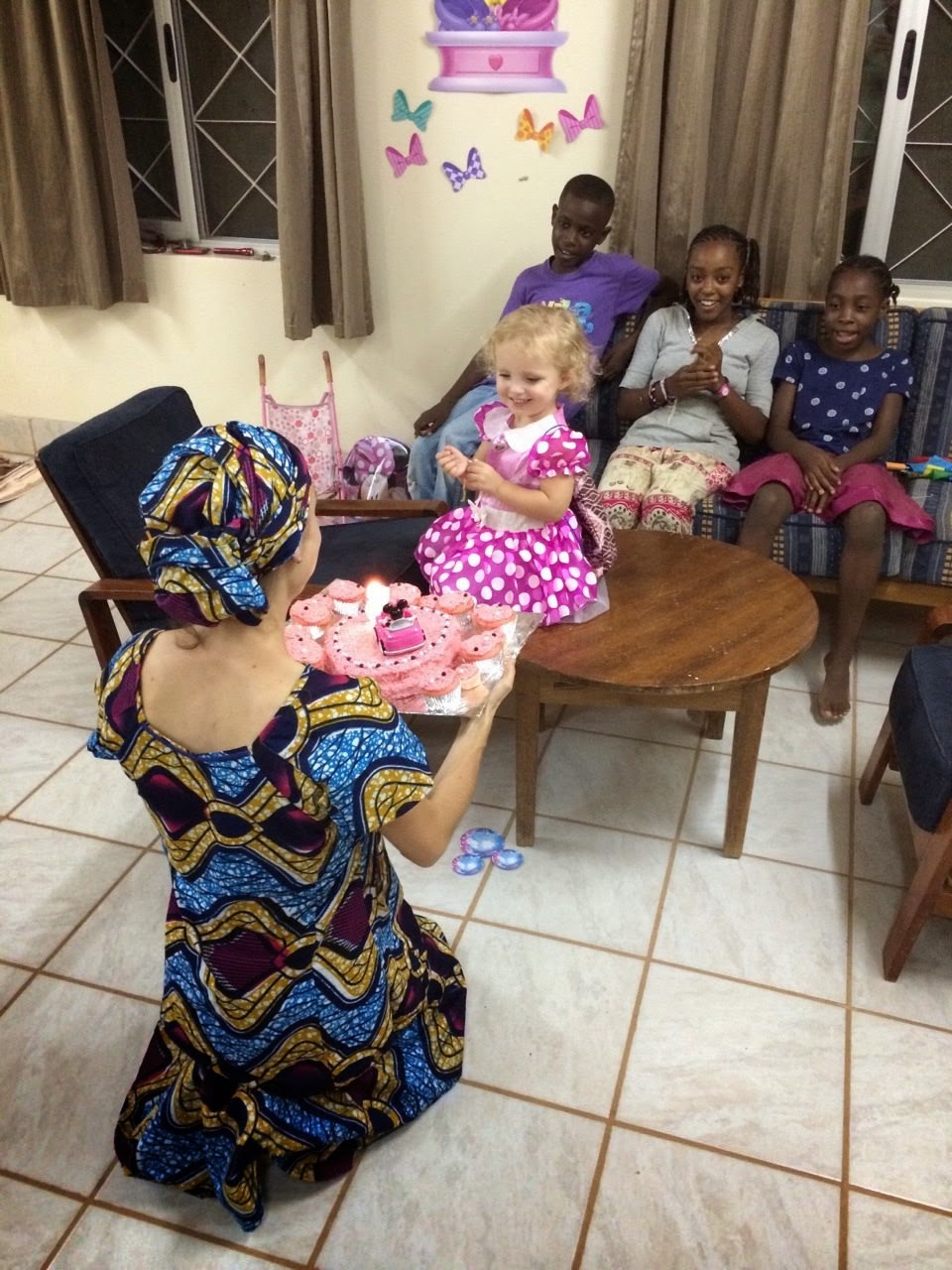
No surprises that Moriah’s birthday theme was Minnie Mouse. We had a day FULL of celebrating! When Moriah woke up, she looked around at some pre-made Minnie decorations hanging on the walls and ceiling. “It looks just like Mickey Mouse clubhouse!” It melted my heart and was a great start to the day. We also got to open a sack of minnie toys I hadn’t brought out yet from home. “These are just like the ones from the yellow house!” was another line I want to remember. Everyone at the hospital and at the school has coffee/snack break at 10am, so we had a short birthday party for Moriah’s friends younger friends. 


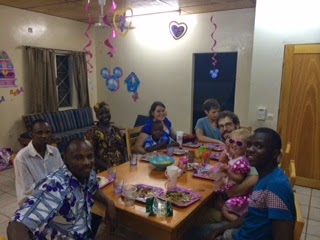
For dinner we had Anna’s family over for dinner and Parker’s translator and friend. I ordered a big pot of rice and sauce from a village woman ahead of time. Anna brought her husband, son, and her husband’s twin. (We had been told if you ever meet a Harry or a Henry you know they are a twin. We were amused to learn that Anna’s husband is Henry and his twin brother is Harry. Apparantly, girl twins have standard names here as well.) Rain was imminent, so unfortunately Anna’s family had to leave quickly so they wouldn’t get stuck in the mud roads. We were disappointed we didn’t get to share Moriah’s story with them, but we loved having them in our home for a short time.


After dinner was finished, some more school-aged friends came over for cupcakes. Moriah’s face when she saw the cake was priceless! “Oh goodness! It’s so cute!” 


If you’re ever looking for a frosting recipe using granulated sugar (because powdered sugar is expensive and hard to find in many countries), this one was delicious. Parker’s friend made up a special birthday song just for Moriah. He has a wonderful voice, and him singing to her was a moment we will treasure.

And, finally, Nick shared Moriah’s story. Before her first birthday, we decided her birthday tradition would be to tell the story of her name… 

Back when I was pregnant with Moriah, we had just bought a house in Wichita and were driving back and forth between Wichita and Iowa City working on our new house and preparing to move. On May 10, we headed back to Iowa City one last time to get our “gender reveal” ultrasound, get Nick graduated from medical school, and move our apartment down to Wichita. We made it back to Iowa City with minutes to spare before the ultrasound appointment, totally exhausted. Nick had nearly pulled an all-nighter tiling our new kitchen floor.

Nick knew the ultrasound tech, and many of the physicians, since he completed his medical training at the hospital. They talked while she performed the ultrasound, and we were thrilled to find out we were having a baby girl. Soon, however, she became quiet. “I’ll be back in just a few minutes,” she said. After awhile, she returned with 3 or 4 other people with her, one of whom was the maternal-fetal medicine specialist (doctor who specializes in problems with pregnancy). They did some more ultra sounding before they FINALLY started talking. 

“Your daughter has what we call a splayed cerebellum. It’s characteristic of a syndrome called Dandy-Walker.” Basically, the back part of her brain wasn’t connected right. In a way, there was a piece missing. They went on to explain that Dandy-Walker ranges in seriousness, some people have minor disabilities, some people have major ones. “Some parents with a child with this condition would terminate the pregnancy, and we can certainly help you with that option if you would like.” We explained that wasn’t a consideration for us and asked a few more questions about Dandy-Walker. 

“Is there any chance that what you’re seeing isn’t actually Dandy-Walker?” I specifically remember asking. 

“No, there is no chance. This is what Dandy-Walker is.”

Nick and I went home to think and cry and process. We prayed, hardly knowing what to say. As days went on, we prayed for her brain to be healed, but mostly, we prayed that God would enable us to love the perfect little girl HE was giving to us. One night Nick was reading Genesis 22 where God asks Abraham to sacrifice his son, his only son, Isaac. This story has so much significance! (Please remember this story is descriptive: it describes. It is not prescriptive: it doesn’t tell us we should do the same.) Isaac was not only loved as a son, but Abraham’s future depended on Isaac: God had told him so! God had promised Abraham ten chapters earlier that God would bless Abraham by giving him many descendants and that through Abraham's descendants, all the world would be blessed. And God promised Abraham that Isaac would be the descendant that would get things rolling. As Nick read the story, I resonated so much with Abraham. What God was asking him to do seemed like a major sacrifice, the ultimate sacrifice, but Abraham believed God was good and would keep His promises. Abraham still believed God would bless him. At the top of the mountain, Abraham has his knife raised to slay his son.

“Abraham! Abraham!” an angel shouted. “Do not lay your hand on the boy…for now I know that you fear God…” Abraham looked over and there was a male sheep caught in a bush. So Abraham offered up the lamb instead. And he called the mountain “The Lord will Provide.” The mountain’s name is Moriah.

I would be lying if I said we had come to the point of total acceptance of God’s not-so-perfect, perfect gift to us. BUT He did give us an unwavering conviction that His gift of this little girl was indeed a blessing, and that she was for our good, even if her needs required all we could give and more. We knew that God would provide for us the very thing he was asking from us. He was asking for selflessness, patience, love, stamina, and perseverance. And we didn’t have enough of those things to last very long, but we believed He would give us more… more patience, more energy, more love. Trembling, we continued to walk up our own mountain believing He would provide what we didn’t have. We believe, Lord, help us in our unbelief.

Four weeks after the first ultrasound, we went back for another. The ultrasound tech looked around for awhile, and once again, told us she would be right back. She came back with another doctor or two who did some more looking.

“Well… her brain is perfectly normal. The piece that was ‘missing' on the first ultrasound is right there.”

.....?!?!?......!?!?!?......!??!?!?!

We continued to talk, and she explained possible reasons for them clearly not seeing it the first time and clearly seeing it the second time. Her explanations are perfectly legitimate, but they don’t really matter. What mattered was this:
  1. When our faith in God’s goodness was tested, He gave us more faith to believe that whatever He gives us is for our good. He provided for us what He was asking from us. Praise be to Him!
  2. Darkness is as light to him. What should have been white on the first ultrasound was dark. He isn’t bound by what we can or cannot see, or by what is 100% chance or 0% chance. He will do what He will do.
Our mountain story had a short timeline before we saw God’s amazing provision of complete healing. I know many people whose mountain is much higher and longer and more difficult than ours. They wait until heaven before they see God’s provision of healing. One friend in particular comes to mind. Doctors said her baby would maybe make it through childbirth. Today she rejoices she has a daughter who is alive at four years old, but she still climbs her mountain of having a daughter with disabilities. And she climbs this mountain rejoicing in God’s provision now - her daughter’s life - and in His provision to come - a new body in heaven that won’t be limited by soft bones!

The Lord will Provide has been my anthem here. Life is hard. It is hot. And when it is hot I still have to wear a skirt to my ankles, a head wrap, and a scarf around my shoulders. And I have kids who are hot. And not pottying in toilets. And then I think about the moms who are watching another child suffer from malaria - the kids' life in question. Or the farmers working hard in the hot sun to make a few dollars on onions and feed their families the same meals everyday - boiled flour balls with some onion and chili peppers. 

Sometimes, God provides a way out - an unexpected lamb, a cool evening because of rain, a healed malaria child. Often times, though, He simply provides the faith to trust He indeed has our good in mind. He doesn't remove the mountain; He asks us to climb it and provides the energy to keep following Him up the path. And one day, what He will provide will make our mountain journey worthwhile. A favorite song lyric from Caedmon’s Call... “Is this the strange feeling of you working all for good? ...We had to walk the rocks to see the mountain view…This is the lead of love.” After all, Jesus’ path to His new body and new life led him up to Calvary. When he says, “Follow me,” should we expect, as Christians, to skip our cross and head straight for streets of gold? Our pain may not be fair... was Jesus's?

Paul, who was super respected as a Jewish leader and who punished people for being Christians, had an encounter with the risen Jesus that changed his life forever. He ended up traveling all over to tell people who hadn’t heard about Jesus’ life, death, and resurrection. In this process, he was beaten and jailed. He wrote the book of Philippians in jail. And in it he says (my paraphrase) “everything I had that once used to bring me respect and power I now count it as bringing me harm compared to what I have now that I know Christ.” He says that from jail. And then he says, “I want to know Christ…becoming like Him in His death, and so, somehow to have new, full life like Jesus” (my paraphrase at the end). Our suffering, our whatever-is-hard-about-our-lives-in-this-world, is what God uses to bring us to the end of ourselves, to our spiritual death, so that we can better be like His son. His son who suffered unfair punishment, spiritually and physically coming to the end of himself, in order that God might raise him from the dead through His Holy Spirit. And He did! On the third day He rose again.

And this same Spirit that raised Christ from the dead works in us when we follow Jesus. When we come to the end of ourselves and put ourselves in God’s care, trusting Him to provide whatever He sees best, His Spirit gives life to our deflated spirit. He raises us up from the dead so to speak. Nick and I believed He would do this in giving us a special needs child, and we know He will do this as Nick tirelessly cares for hurting people. And... so we don’t think our “suffering” has to look super noble or important, I believe He will do this with me as I continue to potty train my 3-year-old with no end in sight. I don’t want to compare cleaning up potty messes in a well-built house with running water to living in a mud hut with potty messes running out a hole in the wall, but I also don’t want to minimize the real moments of my life that are hard. I don’t want to dramatize them, but I don’t want to minimize them… because God uses them to bring me to the end of myself so I can place myself in His care and let His Spirit fill my own deflated one.

There are two kinds of suffering people. One, you are experiencing the day-in, day-out, never-ending demands of life. They are hard, and they zap your energy. They may not compare to what others are enduring, but they make your spirit tired. Don't waste this suffering. It's what God has for YOU. Let Him use it to bring you to the end of yourself and trust in His care. Two, you are going through more difficulty than seems fair for one person to endure. You cannot imagine how a God who is good would let this struggle or tragedy happen in your life. Would God take away someone else's life just to teach you a lesson? No. A resounding no. I don't have explanations. I do have this... God is crazy amazing compassionate: He cares. (Exodus 34:6, Exodus 3:7, Psalm 103). God's ways are higher than ours (Isaiah 55:8-9). We cannot pretend to explain or understand all the injustices in the world, but we can know God became human and voluntarily subjected himself to cruel suffering in order to offer us life. And we can take our honest questions to Him. He is not scared of them.


Ann Voskamp wrote a popular book called One Thousand Gifts. On a certain podcast I can't remember, she says, “His good gifts are forever. His hard gifts are for our good. His best gifts are yet to come.” Amen. The truly good moments? As we follow Jesus, we will enjoy ones like them forever. The hard moments? God uses them in ways we cannot understand - one being to help us trust Him more. The best moments? We can only imagine. Come, Lord Jesus, come.